 Add to Chrome
 Add to Firefox
 Add to Edge
ConVer: Using Contracts and Loop Invariant Synthesis for Scalable Formal Software Verification
May 26, 2026
Formal verification of large C programs is impeded by state-space explosion: Bounded Model Checking (BMC) tools must encode the entire state space up to the predetermined bound by unrolling all nested constructs. We present ConVer, a top-down compositional verification tool. Given a C program with a top-level assertion, ConVer decomposes verification top-down: it uses a large language model (LLM) to synthesise function contracts from the system property, then alternates system-level and function-level checks in a CEGAR-CEGIS loop, refining contracts whenever a check fails via SMART ICE learning. We evaluate ConVer on four benchmark suites of increasing difficulty and against other state-of-the-art (SOTA) tools. On the Frama-C benchmark of 45 simple C programs, ConVer achieves 82-96% verification success across three LLM backends, with 93-95% of converged programs requiring only a single CEGAR-CEGIS iteration. On the X.509 parser benchmark (6~programs) and LF2C-Simple suite (17 programs), ConVer achieves 33-50% and 82-88% success respectively. On the VerifyThis suite of 11 recursive and loop-intensive programs, the Pre-Abstraction strategy achieves 55-64% success. In addition, we present ESBMC-LF a preprocessor tool that converts LF models to C while preserving the properties of the LF files, enabling ConVer to verify them. We transpile the LF Verifier Benchmarks using ESBMC-LF to C; we denote those LF-Hard. We show that ConVer successfully verifies 67% of LF-Hard benchmarks overall.

Steering Beyond the Support: Adversarial Training on Unsupervised Jailbroken Activation Simulation
May 23, 2026Jailbreak prompts can trigger harmful completions on aligned LLMs, In accordance, safety steering has been proposed: test-time activation interventions that steer jailbreak activations to trigger refusal while preserving benign utility. However, existing steering methods are fundamentally supervised and tied to a static, limited training set, whereas real jailbreaks evolve and are often out-of-distributed from the training set, leading to failures on unseen attacks. In this paper, we tackle the failure on unseen jailbreaks problem, base on unsupervised latent direction discovery. We propose a bi-level adversarial training framework for zero-shot jailbreak defense. In the inner step, we simulate diverse jail-broken activations by extrapolating from refusal-state harmful-request activations via unsupervised latent direction discovery, which expands the coverage of real jailbreak activation subspaces. In the outer step, we train a potential-induced steering field to push these adversarial jailbroken states into refusal regions while keeping benign unchanged. Across three LLMs and six classical jailbreak families, our method achieves strong defense with attack success rates mostly below 5%, and rising subspace coverage throughout training helps explain the improved generalization.
EVE: Efficient Verification of Data Erasure through Customized Perturbation in Approximate Unlearning
Feb 03, 2026Verifying whether the machine unlearning process has been properly executed is critical but remains underexplored. Some existing approaches propose unlearning verification methods based on backdooring techniques. However, these methods typically require participation in the model's initial training phase to backdoor the model for later verification, which is inefficient and impractical. In this paper, we propose an efficient verification of erasure method (EVE) for verifying machine unlearning without requiring involvement in the model's initial training process. The core idea is to perturb the unlearning data to ensure the model prediction of the specified samples will change before and after unlearning with perturbed data. The unlearning users can leverage the observation of the changes as a verification signal. Specifically, the perturbations are designed with two key objectives: ensuring the unlearning effect and altering the unlearned model's prediction of target samples. We formalize the perturbation generation as an adversarial optimization problem, solving it by aligning the unlearning gradient with the gradient of boundary change for target samples. We conducted extensive experiments, and the results show that EVE can verify machine unlearning without involving the model's initial training process, unlike backdoor-based methods. Moreover, EVE significantly outperforms state-of-the-art unlearning verification methods, offering significant speedup in efficiency while enhancing verification accuracy. The source code of EVE is released at \uline{https://anonymous.4open.science/r/EVE-C143}, providing a novel tool for verification of machine unlearning.
GeoIB: Geometry-Aware Information Bottleneck via Statistical-Manifold Compression
Feb 03, 2026Information Bottleneck (IB) is widely used, but in deep learning, it is usually implemented through tractable surrogates, such as variational bounds or neural mutual information (MI) estimators, rather than directly controlling the MI I(X;Z) itself. The looseness and estimator-dependent bias can make IB "compression" only indirectly controlled and optimization fragile. We revisit the IB problem through the lens of information geometry and propose a \textbf{Geo}metric \textbf{I}nformation \textbf{B}ottleneck (\textbf{GeoIB}) that dispenses with mutual information (MI) estimation. We show that I(X;Z) and I(Z;Y) admit exact projection forms as minimal Kullback-Leibler (KL) distances from the joint distributions to their respective independence manifolds. Guided by this view, GeoIB controls information compression with two complementary terms: (i) a distribution-level Fisher-Rao (FR) discrepancy, which matches KL to second order and is reparameterization-invariant; and (ii) a geometry-level Jacobian-Frobenius (JF) term that provides a local capacity-type upper bound on I(Z;X) by penalizing pullback volume expansion of the encoder. We further derive a natural-gradient optimizer consistent with the FR metric and prove that the standard additive natural-gradient step is first-order equivalent to the geodesic update. We conducted extensive experiments and observed that the GeoIB achieves a better trade-off between prediction accuracy and compression ratio in the information plane than the mainstream IB baselines on popular datasets. GeoIB improves invariance and optimization stability by unifying distributional and geometric regularization under a single bottleneck multiplier. The source code of GeoIB is released at "https://anonymous.4open.science/r/G-IB-0569".
HeaPA: Difficulty-Aware Heap Sampling and On-Policy Query Augmentation for LLM Reinforcement Learning
Jan 30, 2026RLVR is now a standard way to train LLMs on reasoning tasks with verifiable outcomes, but when rollout generation dominates the cost, efficiency depends heavily on which prompts you sample and when. In practice, prompt pools are often static or only loosely tied to the model's learning progress, so uniform sampling can't keep up with the shifting capability frontier and ends up wasting rollouts on prompts that are already solved or still out of reach. Existing approaches improve efficiency through filtering, curricula, adaptive rollout allocation, or teacher guidance, but they typically assume a fixed pool-which makes it hard to support stable on-policy pool growth-or they add extra teacher cost and latency. We introduce HeaPA (Heap Sampling and On-Policy Query Augmentation), which maintains a bounded, evolving pool, tracks the frontier using heap-based boundary sampling, expands the pool via on-policy augmentation with lightweight asynchronous validation, and stabilizes correlated queries through topology-aware re-estimation of pool statistics and controlled reinsertion. Across two training corpora, two training recipes, and seven benchmarks, HeaPA consistently improves accuracy and reaches target performance with fewer computations while keeping wall-clock time comparable. Our analyses suggest these gains come from frontier-focused sampling and on-policy pool growth, with the benefits becoming larger as model scale increases. Our code is available at https://github.com/horizon-rl/HeaPA.
BlindU: Blind Machine Unlearning without Revealing Erasing Data
Jan 12, 2026Machine unlearning enables data holders to remove the contribution of their specified samples from trained models to protect their privacy. However, it is paradoxical that most unlearning methods require the unlearning requesters to firstly upload their data to the server as a prerequisite for unlearning. These methods are infeasible in many privacy-preserving scenarios where servers are prohibited from accessing users' data, such as federated learning (FL). In this paper, we explore how to implement unlearning under the condition of not uncovering the erasing data to the server. We propose \textbf{Blind Unlearning (BlindU)}, which carries out unlearning using compressed representations instead of original inputs. BlindU only involves the server and the unlearning user: the user locally generates privacy-preserving representations, and the server performs unlearning solely on these representations and their labels. For the FL model training, we employ the information bottleneck (IB) mechanism. The encoder of the IB-based FL model learns representations that distort maximum task-irrelevant information from inputs, allowing FL users to generate compressed representations locally. For effective unlearning using compressed representation, BlindU integrates two dedicated unlearning modules tailored explicitly for IB-based models and uses a multiple gradient descent algorithm to balance forgetting and utility retaining. While IB compression already provides protection for task-irrelevant information of inputs, to further enhance the privacy protection, we introduce a noise-free differential privacy (DP) masking method to deal with the raw erasing data before compressing. Theoretical analysis and extensive experimental results illustrate the superiority of BlindU in privacy protection and unlearning effectiveness compared with the best existing privacy-preserving unlearning benchmarks.
Beyond Accuracy: A Geometric Stability Analysis of Large Language Models in Chess Evaluation
Dec 17, 2025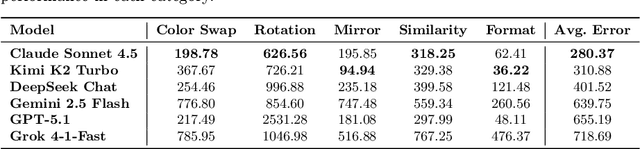
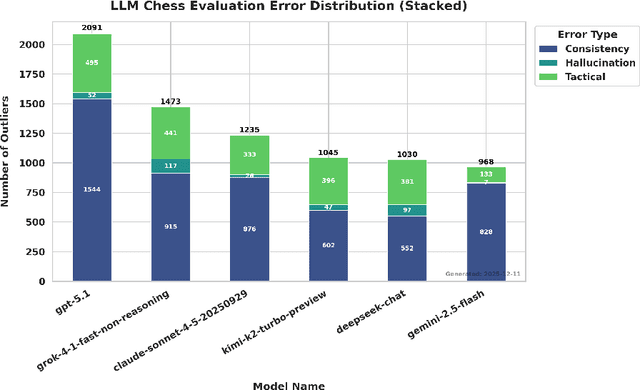
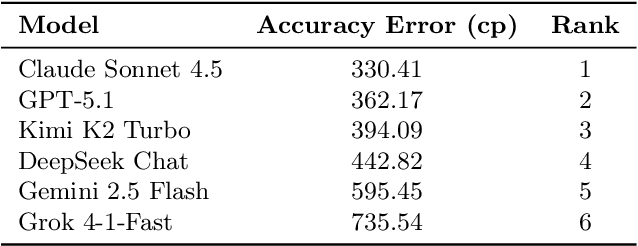
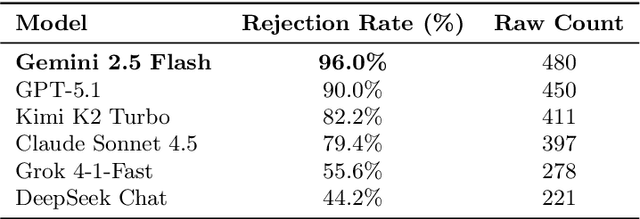
The evaluation of Large Language Models (LLMs) in complex reasoning domains typically relies on performance alignment with ground-truth oracles. In the domain of chess, this standard manifests as accuracy benchmarks against strong engines like Stockfish. However, high scalar accuracy does not necessarily imply robust conceptual understanding. This paper argues that standard accuracy metrics fail to distinguish between genuine geometric reasoning and the superficial memorization of canonical board states. To address this gap, we propose a Geometric Stability Framework, a novel evaluation methodology that rigorously tests model consistency under invariant transformations-including board rotation, mirror symmetry, color inversion, and format conversion. We applied this framework to a comparative analysis of six state-of-the-art LLMs including GPT-5.1, Claude Sonnet 4.5, and Kimi K2 Turbo, utilizing a dataset of approximately 3,000 positions. Our results reveal a significant Accuracy-Stability Paradox. While models such as GPT-5.1 achieve near-optimal accuracy on standard positions, they exhibit catastrophic degradation under geometric perturbation, specifically in rotation tasks where error rates surge by over 600%. This disparity suggests a reliance on pattern matching over abstract spatial logic. Conversely, Claude Sonnet 4.5 and Kimi K2 Turbo demonstrate superior dual robustness, maintaining high consistency across all transformation axes. Furthermore, we analyze the trade-off between helpfulness and safety, identifying Gemini 2.5 Flash as the leader in illegal state rejection (96.0%). We conclude that geometric stability provides an orthogonal and essential metric for AI evaluation, offering a necessary proxy for disentangling reasoning capabilities from data contamination and overfitting in large-scale models.
NewtonBench: Benchmarking Generalizable Scientific Law Discovery in LLM Agents
Oct 08, 2025Large language models are emerging as powerful tools for scientific law discovery, a foundational challenge in AI-driven science. However, existing benchmarks for this task suffer from a fundamental methodological trilemma, forcing a trade-off between scientific relevance, scalability, and resistance to memorization. Furthermore, they oversimplify discovery as static function fitting, failing to capture the authentic scientific process of uncovering embedded laws through the interactive exploration of complex model systems. To address these critical gaps, we introduce NewtonBench, a benchmark comprising 324 scientific law discovery tasks across 12 physics domains. Our design mitigates the evaluation trilemma by using metaphysical shifts - systematic alterations of canonical laws - to generate a vast suite of problems that are scalable, scientifically relevant, and memorization-resistant. Moreover, we elevate the evaluation from static function fitting to interactive model discovery, requiring agents to experimentally probe simulated complex systems to uncover hidden principles. Our extensive experiment reveals a clear but fragile capability for discovery in frontier LLMs: this ability degrades precipitously with increasing system complexity and exhibits extreme sensitivity to observational noise. Notably, we uncover a paradoxical effect of tool assistance: providing a code interpreter can hinder more capable models by inducing a premature shift from exploration to exploitation, causing them to satisfice on suboptimal solutions. These results demonstrate that robust, generalizable discovery in complex, interactive environments remains the core challenge. By providing a scalable, robust, and scientifically authentic testbed, NewtonBench offers a crucial tool for measuring true progress and guiding the development of next-generation AI agents capable of genuine scientific discovery.
The Cognitive Bandwidth Bottleneck: Shifting Long-Horizon Agent from Planning with Actions to Planning with Schemas
Oct 08, 2025Enabling LLMs to effectively operate long-horizon task which requires long-term planning and multiple interactions is essential for open-world autonomy. Conventional methods adopt planning with actions where a executable action list would be provided as reference. However, this action representation choice would be impractical when the environment action space is combinatorial exploded (e.g., open-ended real world). This naturally leads to a question: As environmental action space scales, what is the optimal action representation for long-horizon agents? In this paper, we systematically study the effectiveness of two different action representations. The first one is conventional planning with actions (PwA) which is predominantly adopted for its effectiveness on existing benchmarks. The other one is planning with schemas (PwS) which instantiate an action schema into action lists (e.g., "move [OBJ] to [OBJ]" -> "move apple to desk") to ensure concise action space and reliable scalability. This alternative is motivated by its alignment with human cognition and its compliance with environment-imposed action format restriction. We propose cognitive bandwidth perspective as a conceptual framework to qualitatively understand the differences between these two action representations and empirically observe a representation-choice inflection point between ALFWorld (~35 actions) and SciWorld (~500 actions), which serve as evidence of the need for scalable representations. We further conduct controlled experiments to study how the location of this inflection point interacts with different model capacities: stronger planning proficiency shifts the inflection rightward, whereas better schema instantiation shifts it leftward. Finally, noting the suboptimal performance of PwS agents, we provide an actionable guide for building more capable PwS agents for better scalable autonomy.
Structuring the Unstructured: A Systematic Review of Text-to-Structure Generation for Agentic AI with a Universal Evaluation Framework
Aug 17, 2025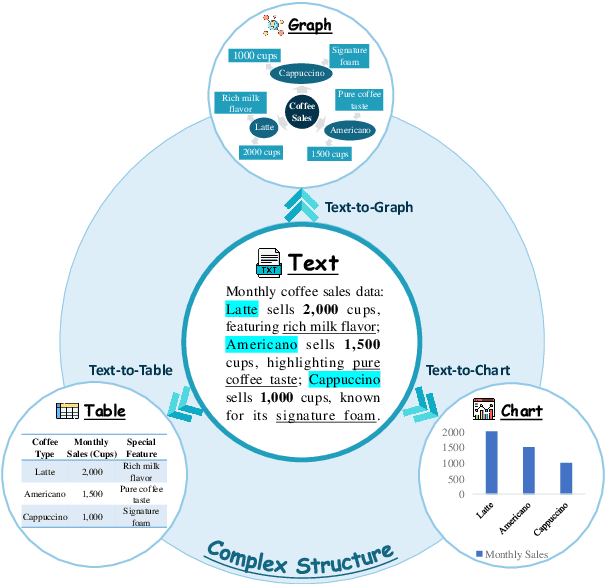
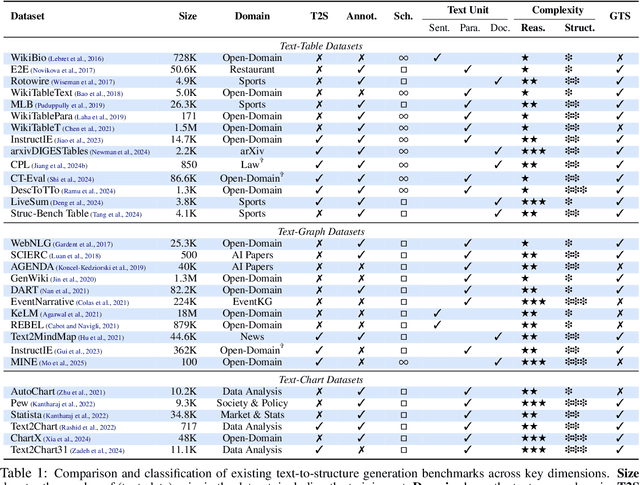
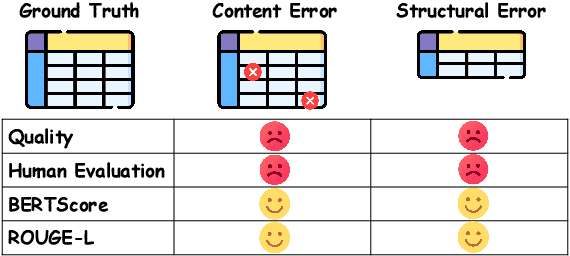
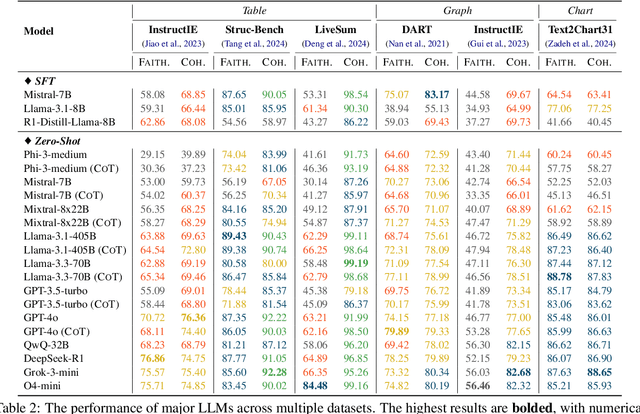
The evolution of AI systems toward agentic operation and context-aware retrieval necessitates transforming unstructured text into structured formats like tables, knowledge graphs, and charts. While such conversions enable critical applications from summarization to data mining, current research lacks a comprehensive synthesis of methodologies, datasets, and metrics. This systematic review examines text-to-structure techniques and the encountered challenges, evaluates current datasets and assessment criteria, and outlines potential directions for future research. We also introduce a universal evaluation framework for structured outputs, establishing text-to-structure as foundational infrastructure for next-generation AI systems.